
Season 8’s World Championship in Madrid was one of the most exciting Rocket League tournaments in recent history, in part due to a successful bracket format and in part due to Garrett G not stopping until he got to lift that trophy. There are a few notable decisions the organizers made which I had trouble immediately understanding.
Why did the losers of the first round and the losers of the second round of the group stage land in the same round of the loser’s bracket? Why does the winner of the group final advance to the Semifinal and the loser of the group final not go to the loser’s bracket?
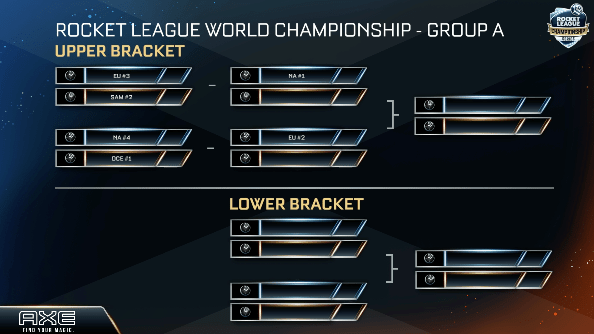
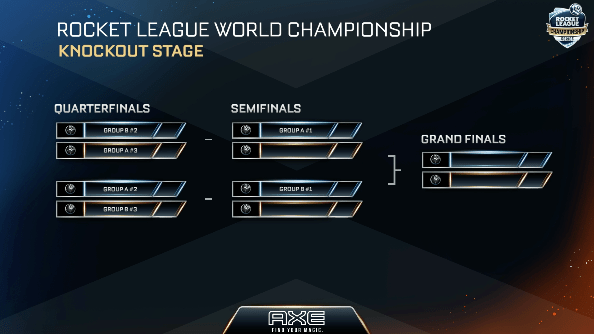
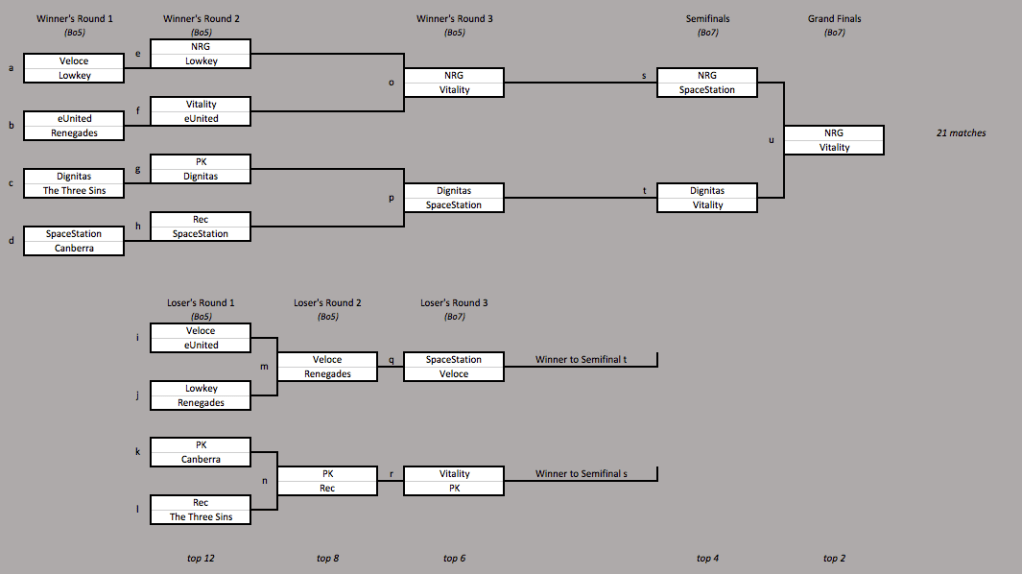
To answer these questions and to create some alternative options to consider, I visualized the season 8 format as such:
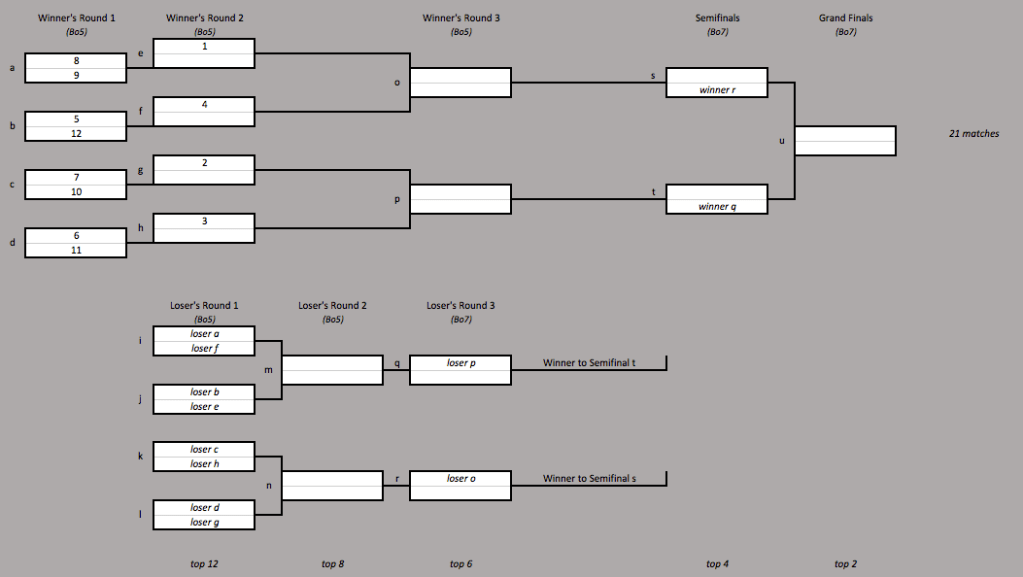
Note here I stay away from using Group A/B notation, but the movement through the bracket remains the same. The seeding is arbitrary; I won’t touch on seeding in this article. Note that the Quarterfinals have been moved to the loser’s bracket and renamed Loser’s Round 3. This change in notation makes it clearer that the loser of the group final (now Winner’s Round 3) is penalized with a trip to the loser’s bracket.
Standard Double Elimination
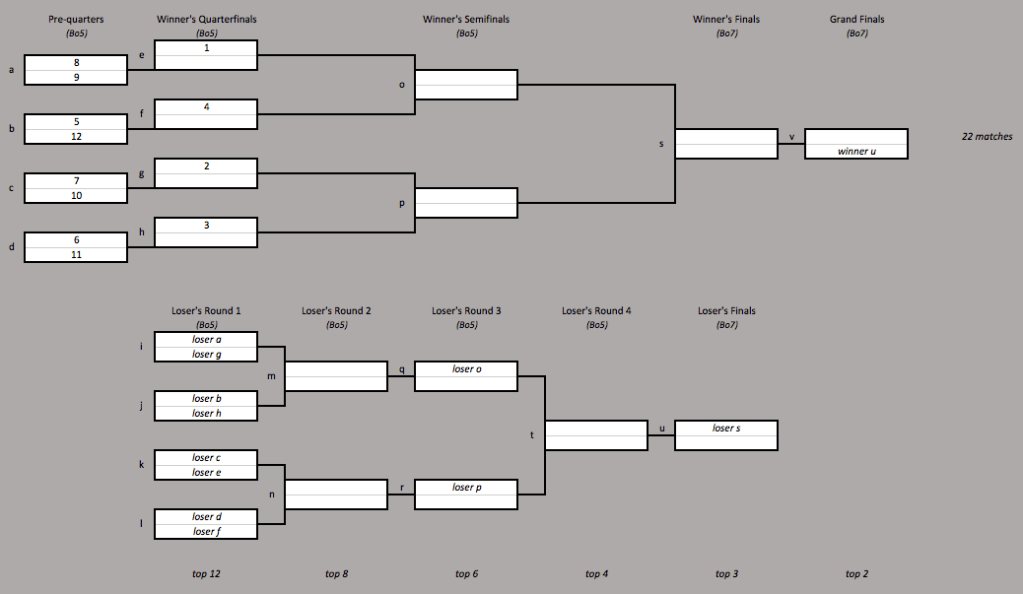
The question is, is the season 8 format preferable to a traditional double elimination bracket? Day 1 and Day 2 remain unchanged with this structure, but Day 3 has a slight tweak. The advantage of a standard double elimination is that the top two teams in the winner’s bracket still have an extra life going into the final rounds instead of immediately playing an elimination game.
See Dignitas’ Season 8 run in Madrid (below). They won three straight matches to advance to the semifinals, only to be knocked out by Renault Vitality in the single elimination bracket. They were the only team to lose only 1 match and not win the tournament. Had it been a standard double elimination bracket, Dignitas would have played NRG in the winner’s finals. Had Dig lost there, they would play the winner of Vitality/SpaceStation in the Loser’s Finals instead of being knocked out of the tournament. Additionally, this also forces the 4 teams in loser’s round 3 (who are all top 6 at this point) to win 2 Best-of-5s to reach the Semifinals rather than just 1 Best-of-7, thus penalizing these teams more for losing earlier in the tournament.
Arguably, the double elimination tournament gives a harder path to the Grand Finals because the top two teams in the winner’s bracket must face the strongest remaining competitor in the tournament. The loser has a momentum disadvantage in the loser’s finals because they just lost a match and their opponent just won two.
So, if you are Dignitas, would you rather play NRG in the winner’s finals to get to the Grand Finals, knowing that if you lose, you will face the winner of Vitality/SpaceStation who just won two straight matches? Or would you take your chances against Vitality in an elimination game?
From a stream time standpoint, day 3 would consist of 3 BO5s followed by 3 BO7s compared to the 5 BO7s. If we assume an average of 4 games/match for a BO5 and 5.5 games/match for a BO7, a double elimination Day 3 would take on average 1 additional game (28.5 vs. 27.5) plus an extra break in between matches – this may amount to 15-30 more minutes than the current format.
Round Robin Group Stage
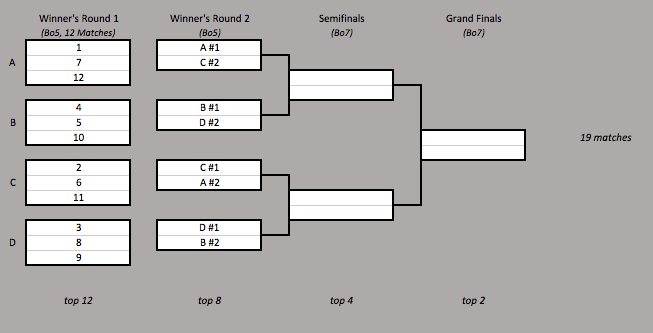
Maybe you preferred the Group Stage format from Season 7? The thing I liked about this format was the 8-team bracket on Day 3. The notion of seven elimination matches is exciting! However, the potential for tiebreakers in the group stage makes this a non-starter for me. Maybe if this was a 4-day tournament, I would like to see BO7 quarterfinals on Day 3 and Semifinals and Finals on Day 4.
Loser’s Bracket
The other option I would like to propose is a more robust loser’s bracket. I did not like that the losers of the first round in the tournament got placed in the same elimination matches as the losers of the second round. To me, this does not adequately reward a win in the first round of the tournament. I created an extra round in the loser’s bracket so that the losers of the first round had to play each other first, much like in Season 6 and prior.
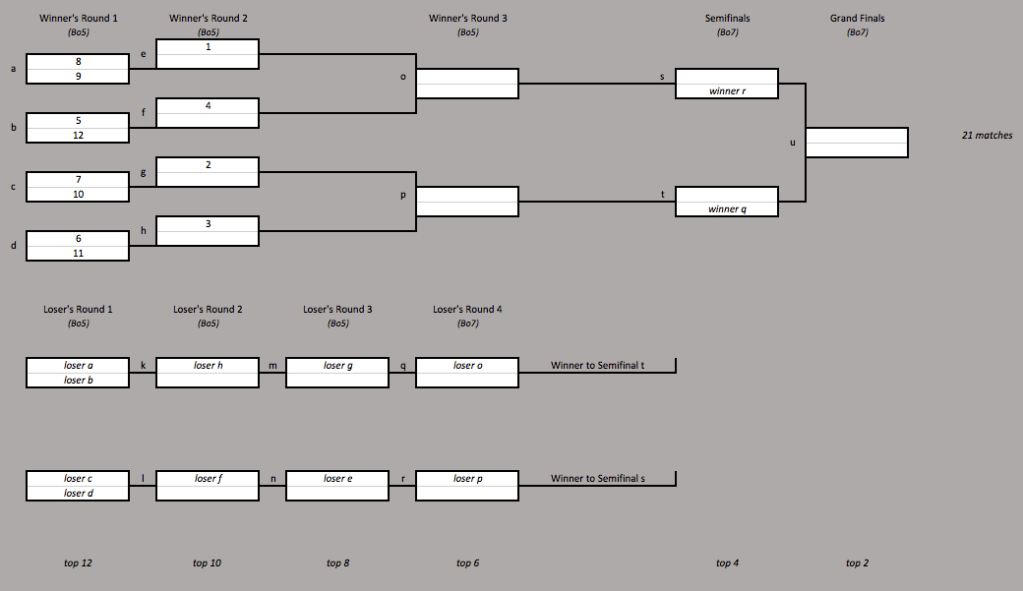
The issue then becomes, there are two winners in loser’s round 1 and four loser’s in winner’s round 2. To solve this, the losers in matches reserved for the NA/EU #2 seeds (f and h, above) are placed into loser’s round 2 and the losers in matches reserved for the NA/EU #1 seeds (e and g, above) are placed into loser’s round 3. The rest of the bracket plays out the same way (note that matches q and r in each format all have the losers from matches o and p).
The main advantage of this gauntlet style bracket is that the winners of the first round are automatically top 10 and do not get put in the first round of the loser’s bracket. The other feature is that every team will win at least one match except for two teams, compared to a potential four winless teams in the current format. This also sets the stage for a crazy 6 round lower bracket run similar to Cloud 9’s run in season 6. Fourth, this gives the NA/EU #1 seeds a slight advantage over the #2 seeds besides just seeding. Lastly, this requires no additional matches to be played throughout the tournament and can be employed in both the double to single elimination bracket and the double elimination bracket.
The disadvantages include that the winners of the first round that move on to face the NA/EU #1 seed (matches a and c, above) have an advantage over the teams who get unlucky enough to face the NA/EU #2 seed. Theoretically, the #1 and #2 seeds from both regions should win the second round match, so giving an advantage to only half of the remaining 8 teams that happen to be placed in that half of the bracket is a bit arbitrary. Though, it can be argued that the #1 seeds (e and g) are harder to defeat than the #2 seeds, so teams should be punished less for drawing into the harder matchup. This is how they do it in season 6 and prior, after all.
Additionally, every match in the loser’s bracket except for the first involves a team that just lost from the winner’s bracket. One may prefer to see the winners from the first loser’s round to play head to head in a bracket style elimination, but this is purely personal preference.
Bracket Resets: Good or Bad? Or really bad?
The last option I want to discuss is the bracket reset. In a double elimination tournament, the grand final typically includes a bracket reset for the team from the winner’s finals because they have yet to lose a match in the tournament and the loser’s finalist has already lost one. However, some tournaments, such as DotA’s premier championship, The International, do not use the bracket reset option, and I see why. For DotA 2, a BO5 lasts longer than a cricket match, so two BO5s is likely not appropriate. For games where having a bracket reset is time-feasible, I would argue that it is unnecessary. The purpose of a double elimination tournament is to more accurately find the top teams in the tournament. Upsets are balanced over the course of a few loser’s bracket rounds, and the cream rises to the top. I argue that once the top two teams reach the grand final, the double elimination format has done its job. The team that has won every match to reach this point no longer needs a second life to reach the final because they are already there! If they were to lose in the first match of the grand final, then they should rightfully be awarded second place despite it being their only loss, because we should place the totality of the importance on that match! This is one reason for having a double to single elimination bracket like in this season, but even in a double elimination setting I think having a bracket-reset-less grand final is most exciting and still fair.
Personal Conclusions
After thinking about this for a long time, I think the season 8 format (pictured first) is the best option for the tournament. This is primarily because Day 3 is primed to be the most exciting out of all. I think having a semifinal and grand final is superior to having winner’s and loser’s finals and superior to having an extra round between the “quarterfinals” (loser’s round 3) and the loser’s finals. I don’t think the extra rounds for day 3 in a double elimination bracket produce demonstrably better grand finalists than in the current format and it takes longer to get there. Best of 7 quarterfinals are fantastic as well. As for the first round of the loser’s finals, I prefer a bracket style over a gauntlet style for the simple reason that more loser’s rounds aren’t particularly fun. Even though it is the same number of matches, I can’t help but think it would feel a little more drawn out. That said, I think a gauntlet style loser’s bracket IS more fair, especially to teams who won the first round. I would also like to see a distinction between 9/10th and 11/12th place teams, though it is unimportant compared to how the top teams are placed.
Reader participation:
Which overall format do you prefer?
- Double Elimination to Top 6 Single Elimination – (Season 8 format, current)
- Double Elimination – (Winner’s/Loser’s Finals rather than Quarter/Semifinals)
- Group Stage to Top 8 Single Elimination – (Season 7 format)
Unless you prefer the Group Stage, which style of Loser’s Bracket would you prefer?
- Bracket style Loser’s Bracket – (1 Loser’s Bracket round to decide top 8, current)
- Gauntlet style Loser’s Bracket – (2 Loser’s Bracket rounds to decide top 8)
If you prefer a double elimination tournament, would you include a bracket reset for the Winner’s Final victors?
- Bracket Reset
- No Bracket Reset
Thanks for reading.
 Hoffblogs Music Blog About Music